Different borrowing methods

Borrowing money is something most people will encounter at some point in their lives, whether it’s to manage short term expenses, spread out the cost for larger purchases, or support longer term financial goals. There are many different borrowing products out there, and each are designed for different situations. Understanding how they work is an important first step before making any financial borrowing decision.
This page provides general financial information for educational purposes only, not personalised advice.
The content on this website reflects financial rules and systems in England and may differ in other parts of the UK.
Why borrowing can be beneficial
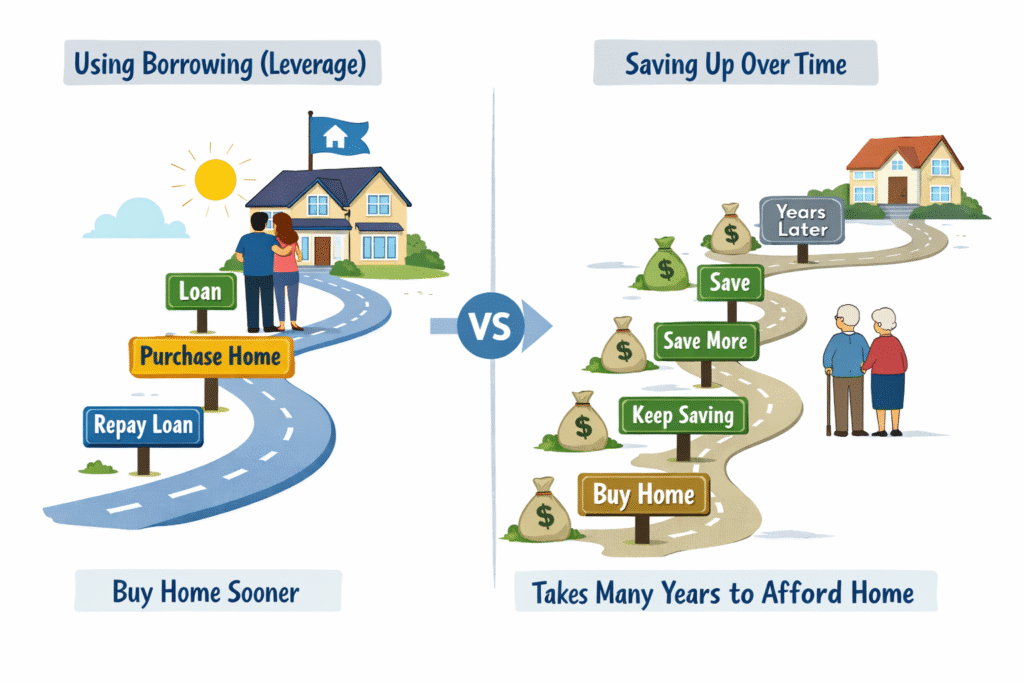
Borrowing can be beneficial when it is used deliberately and for a clear purpose. Rather than simply covering short term gaps, borrowing can act as a financial tool that allows people to access opportunities sooner than would be possible through saving alone. this concept is often referred to as leverage, it involves using borrowed money to bring forward significant life goals, such as buying a home, education costs, or other essential larger purchases that help support everyday living.
In many cases, borrowing enables participation in major milestones that are otherwise unrealistic without external funding, for example purchasing property. For most people, saving up money to buy a house would take many years, borrowing would help spread the cost of the high value asset over a longer period of time, making them more accessible while allowing people to keep earning , saving, and even planning retirement.
Borrowing can even provide structure and predictability to personal finances by covering large, one off, costs to manageable and scheduled repayments. This can help with budgeting and cash flow management, particularly when expenses are necessary. Because of this, borrowing is often viewed positively when it comes to supporting long term stability, improving the quality of life, or helping individuals progress through the different stages of their financial life cycle, providing that it aligns with their personal circumstances.
Drawbacks to borrowing
While borrowing can offer flexibility and opportunity, it also comes with costs that should be understood over time. The simplest one to understand being the interest, which represents the price paid for accessing money sooner rather than later. Even when repayments are made on time, borrowing typically means paying back more than the original amount borrowed. Some borrowing products may include fees or charges which can increase the overall cost without being obvious to see.
Borrowing can also impact someone’s credit history, however this can go both positively and negatively. Managed well with payments on time, will demonstrate reliability, but late or even missed payments will show the opposite, which may result in a credit score drop. These changes are often gradual, but they may affect access to future borrowing or influence the terms offered. This shows that borrowing isn’t just a short term commitment but something that can shape financial options over a longer period.
Where situations may become more serious, borrowing can result in more serious risks. Having ongoing repayment difficulties may lead to arrears, defaults, or formal actions such as County Court Judgements (CCJs), while failed business borrowing can leave lasting financial and legal consequences. These outcomes typically develop over time rather than suddenly, often following prolonged financial strain or changes in circumstances. For this reason, the risks of borrowing are closely tied to affordability, stability, and how well the borrowing aligns with an individuals wider financial position./
Understanding different borrowing products
Credit Cards – Short term borrowing designed for everyday spending and flexibility. Can be good for unexpected expenses and building a good credit history, but comes with higher interest rates if left uncleared.
Personal loan – A fixed amount borrowed over an agreed term usually with set repayments. Usually used for larger, one off payments where spreading the cost out is more manageable. Interest rates depend on the lender, term length, and credit profile.
Payday Loan – Avery short term borrowing method intended to cover important cash shortfalls until the next day paid. Often with high costs and best kept away from long term planning.
Overdraft – A facility linked to a current account that allows spending past the individuals available balance. Best suited for short term cash flow as fees can add up overtime if left unmanaged. Tends to be higher interest.
Store Card – A form of credit tied to a specific retailer, may offer promotions or discounts. Interest is usually higher then a standard credit card.
Buy Now Pay Later – Allows purchases to be split into smaller instalments, often interest free if payments are made on time. Missed payments may lead to potential credit impacts.
Mortgage – Long term borrowing method used to purchase property. Repayments are spread across many years with average being 25-30 years. Lower interest rates in exchange for security on the property, and longer term borrowing.
Bridging Loans – Short term, property backed borrowing typically used to cover a gap between buying and selling a property, or when in need of quick access to funding is required. Usually last for a few months and up to a year with higher interest rates and fees due to these loans being shorter term. Repayment comes from a future event such as sale of a property.
Equity Release – A form of borrowing available to homeowners that allows access to some of the value built up in their property. The most common form allows money to be released as a lump sum or in stages, with added interest over time. Repayment is usually made when the property is sold.0
Misconceptions for borrowing
A common misconception is that borrowing becomes a negative sign of poor financial management, in reality, borrowing is a widely used financial tool that plays an impactful role at many stages of life, from education, home ownership, business, and personal cash flow. The impact of borrowing depends far more on how it is used, the time frame involved, and how well it aligns with an individuals circumstances, rather than the act of borrowing itself.
As I have explained many times, credit scores can be boosted by borrowing, but many think the opposite, borrowing does not automatically harm someone’s credit history, a constant issue with irregular or missed repayments will. This misconception leads people away from credit options entirely, even when some form of structured borrowing could be manageable or appropriate for their situation.
Another misconception is that borrowing decisions are judged in isolation. In practise, borrowing is almost always assessed in the context of the wider financial picture, including income, existing commitments, stability, and future expectations. The same borrowing product may be viewed very differently depending on an individuals circumstances, meaning what appears manageable for some may be unsuitable for others. Having this misunderstanding can lead to oversimplified views of borrowing as either “good” or “bad”, rather than recognising its impact is very situational and changes over time.
How using different borrowing products change over an individuals life cycle
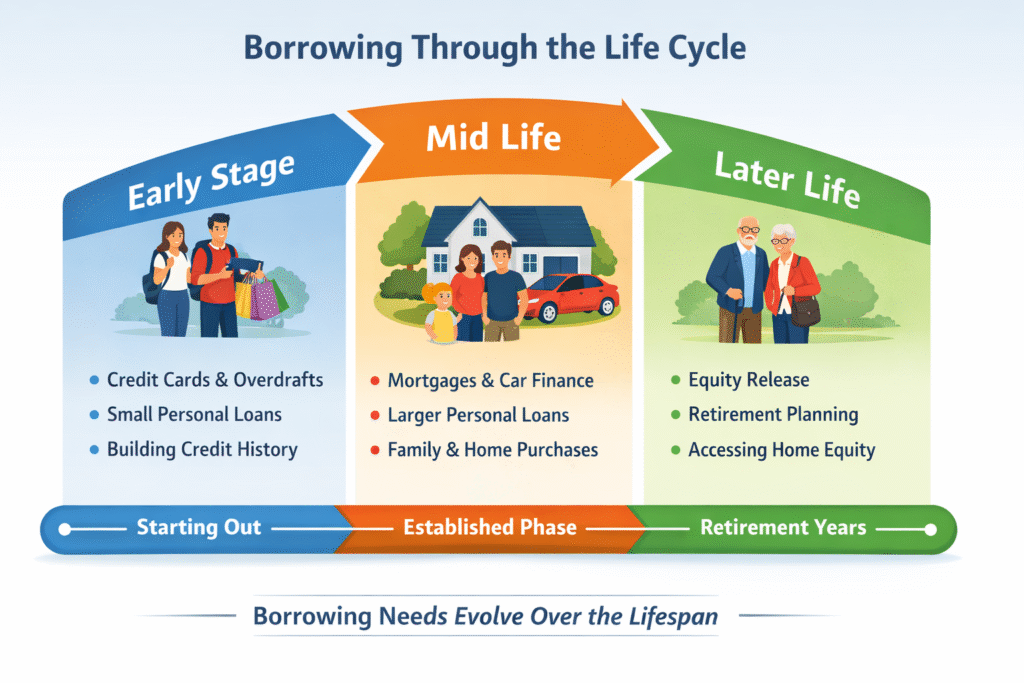
Borrowing needs and patterns tend to evolve as an individual moves through different stages of life. Outlined below will be a basic example of how this can be shown from an earlier stage of life, making the way towards later life.
Early stage – Borrowing is often limited in both amounts and product variety, but more focused with flexibility. Individuals may have lower incomes and little to no credit history, making borrowing more about managing short term needs and building a financial track record. The more common products for this stage would involve a small personal loan, overdrafts, and credit cards.
Borrowing of often used to cover unexpected costs or perhaps help build up a financial footprint. While borrowing amounts may be modest, how these products are managed can influence future access to credit. Leverage isn’t the main idea here, but more of an understanding on how borrowing works with everyday finances.
Mid life – Financially stability should have increased along side income meaning borrowing should become more structured and leaning towards longer term. This stage often includes higher value commitments that may include mortgages, car finances, and even larger personal loans. Borrowing here is usually planned and may become tied to assets or longer term goals. Alongside this, credit cards still stay relevant as well as an overdraft for a current account to help act as a supported safety net.
Later life – Major assets should already be in place at this point in life, borrowing all together may be reduced. Unlike the other stages, products such as equity release may become relevant to some homeowners, allowing access to property wealth without taking on any traditional monthly repayments.
Borrowing decisions, if any, are typically influenced by retirement income, lifestyle preferences, and long term planning considerations. A shift from growth to maintaining financial comfort and stability takes place, displaying how borrowing evolves alongside changing personal and financial circumstances.